

The Two Pillars for Succeeding in a Complex Technological Project
Introduction
Today, in the face of ever-faster technological advancement, succeeding in an ambitious technological project is a gamble. The keys to success are no longer limited to simply meeting deadlines or controlling costs. The challenge now is to harmonize a set of skills, methods, and closely related technical specialties.
To create long-term value, effective management must combine two approaches: on the one hand, excellence in the immutable principles of project management; on the other, in-depth knowledge of current technological ecosystems. Through two complementary diagrams, this article aims to explore these two aspects by detailing the key skills and their field of application.
Mastering the Fundamentals of Program Management
Before diving into technical complexity, it is crucial to have a robust management toolbox. The diagram below maps the essential skills that form the foundation of any successful program or project.

This model organizes expertise into three distinct zones:
- The methodological pillars (left and right columns): they include Integration Management to ensure overall consistency, Agile Methodology for flexibility, Risk Management for anticipation, and Change Management for adaptability. These skills form the strategic framework for navigating uncertainty.
- The operational engine (central column): this is the heart of the reactor. It brings together the daily management disciplines: aligning stakeholders, streamlining communications, optimizing resources and procurement, and mastering costs, time, scope, and quality.
- The strategic vision: at the base of this structure is the ability to implement a strategy and measure it via key performance indicators (KPIs), ensuring that every action contributes to the company’s objectives.
Possessing these skills is the first condition for success. But to be truly effective, they must be applied to a specific context.
Navigating the Ecosystem of Complex Technological Projects
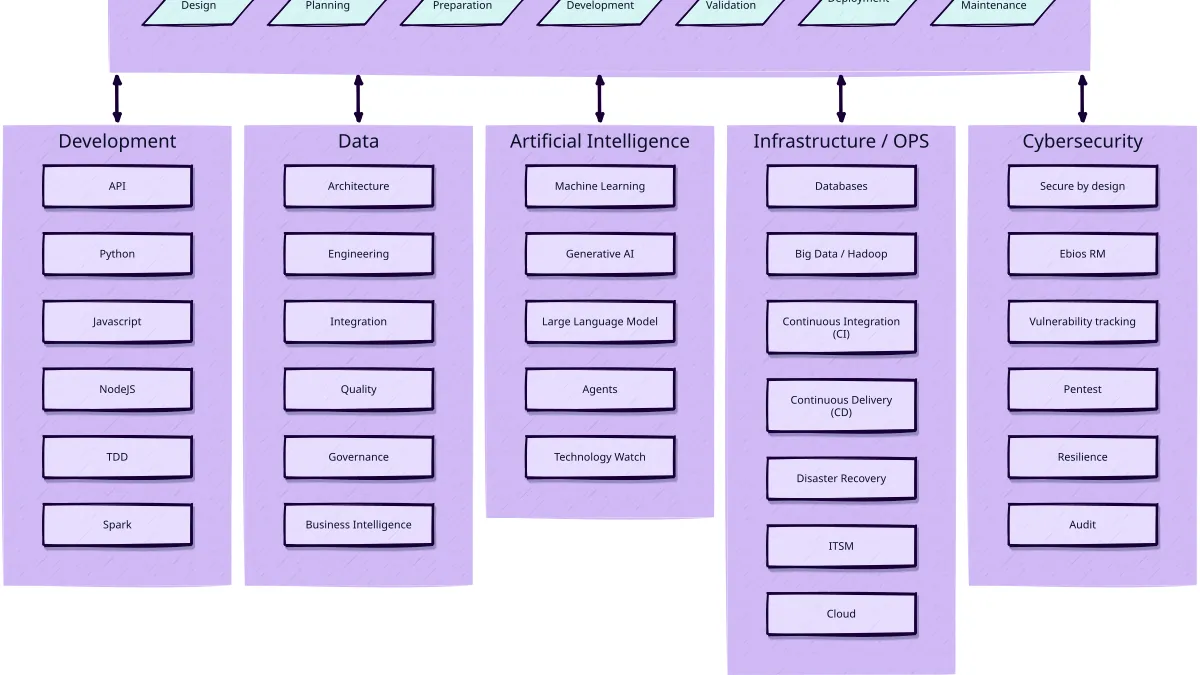
This second diagram illustrates the playing field: the interdependent ecosystem of a modern complex technological project. It highlights not linear stages, but a network of expertise that constantly interacts.

Here is how to read this representation:
- The project’s backbone (horizontal): it represents the key phases, from initial ideation to monitoring and maintenance in production. This is the path that value follows, from idea to real impact.
- The technical disciplines (vertical): five critical areas gravitate and constantly interact with this path: Development, Data, Artificial Intelligence, Infrastructure (Ops), and Cybersecurity.
A final important message: cybersecurity is not “done” only at the end of development; it is integrated “by design” from the ideation phase. Similarly, Data expertise is called upon at every stage, from model design to production pipeline monitoring. The project’s success depends on the harmonious orchestration of these five disciplines throughout its life cycle.
Conclusion
Taken separately, these two diagrams offer useful reference frameworks. But their true power is revealed when they are superimposed: expertise in technological program management consists of applying the skills of the first diagram to steer and synchronize the complex ecosystem of the second.
Soon, in a future article, I will address the main differences between this approach and a more Product-oriented approach, particularly in the Data field.
Salvatore Russo